
Additional Compensation Strategies for Canadian Business Owners
Beyond the fundamental salary versus dividend analysis, Canadian business owners have access to sophisticated compensation strategies that can significantly enhance tax efficiency and retirement planning outcomes. These advanced strategies become particularly valuable for higher-income earners and business owners seeking to optimize their overall compensation packages.
Individual Pension Plans (IPPs)
Enhanced Retirement Savings for Business Owners
Individual Pension Plans represent one of the most powerful retirement savings vehicles available to incorporated business owners, particularly those over age 40 with annual T4 income exceeding $100,000.
Key Advantages:
- Age-Based Contribution Increases: IPP contribution limits increase significantly with age, from $32,300 at age 45 to $47,300 at age 65
- Past Service Recognition: Can recognize up to 35 years of past service for enhanced contributions
- Terminal Funding: Additional catch-up contributions available at retirement
- Creditor Protection: Full protection from creditors under pension legislation
- Tax Efficiency: 100% tax-deductible corporate contributions with tax-deferred growth
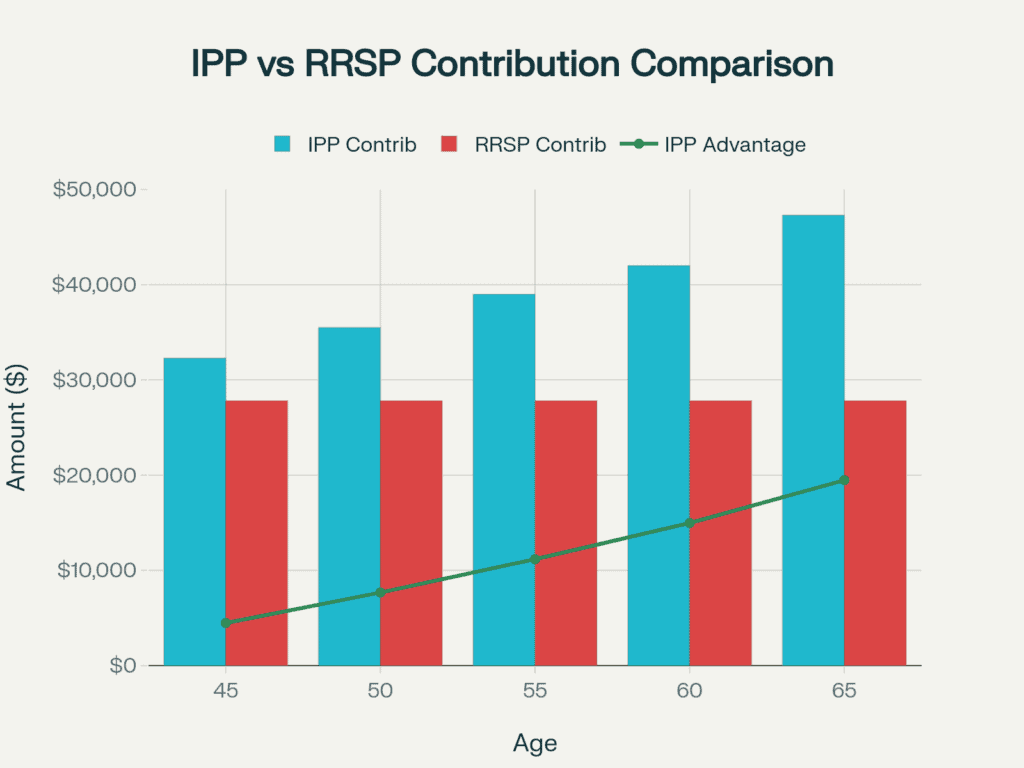
Individual Pension Plan (IPP) vs RRSP Contribution Advantages by Age – Maximum annual contributions showing increasing IPP benefit with age
IPP Implementation Requirements
Corporate Structure Requirements:
- Business must be incorporated (professional, regular, or personal services corporation)
- Member must receive T4 employment income
- Actuarial services required for setup and ongoing administration
- Annual reporting and triennial valuations mandatory
Optimal Candidates:
- Age 40+ for maximum benefit realization
- Annual salary $100,000+ to justify setup costs
- Consistent corporate profits to fund contributions
- Desire for creditor-protected retirement savings
Retirement Compensation Arrangements (RCAs)
Non-Registered Excess Benefit Plans
RCAs provide a sophisticated solution for high-income earners whose retirement income needs exceed registered plan limits. These arrangements offer significant flexibility while maintaining important tax deferral benefits
Tax Mechanics:
- Employer Deduction: 100% tax-deductible corporate contributions
- Refundable Tax: 50% withholding tax on contributions and income
- Employee Taxation: Only when benefits received (potentially at lower rates)
- Tax Refund: 50% refunded when distributions commence
Strategic Applications:
- Supplement registered pension plan benefits above Income Tax Act limits
- Provide retention benefits for key executives
- Create flexible retirement income streams
- Support estate planning objectives for business owners
Example RCA Analysis
A $100,000 corporate contribution results in $50,000 net investment after refundable tax. After 10 years at 6% growth, the total available benefit becomes $139,542 (including tax refunds).
Employee Stock Options
CCPC vs. Public Company Distinctions
The tax treatment of employee stock options varies significantly between Canadian-controlled private corporations and public companies, creating important planning opportunities
CCPC Advantages:
- Deferred Taxation: No tax until shares sold
- Enhanced Deduction: 50% deduction available even with discount pricing
- Flexible Terms: Exercise price can be below fair market value at grant
- No Annual Limits: Not subject to $200,000 vesting restrictions
Public Company Limitations (Post-June 2021)
- Immediate Taxation: Tax on exercise of options
- Strict Conditions: Exercise price must equal grant-date fair market value
- Vesting Limits: $200,000 annual limit on deductible options
- Proposed Changes: Deduction may reduce from 50% to 33.3%
Tax Calculation Example:
- Option grant: $30 per share
- Exercise price: $50 per share (100 shares)
- Employment benefit: $2,000
- With 50% deduction: $350 tax (35% rate)
- Without deduction: $700 tax
Phantom Stock Plans
Cash-Based Equity Participation
Phantom stock plans provide employees with cash payments based on share value appreciation without actual equity transfer. These plans offer maximum flexibility for private companies while avoiding ownership dilution.
Canadian Tax Treatment:
- Employment Income: Fully taxable as ordinary income (no capital gains treatment)
- Timing Rules: Payment must occur by end of third year following service year
- Employer Deduction: Available when payment made to employee
- Accounting Impact: Mark-to-market compensation expense and liability
Design Flexibility:
- Vesting Schedules: Customizable based on performance or tenure
- Trigger Events: Retirement, sale transaction, or performance milestones
- Valuation Methods: Formula-based or external valuation processes
- Payment Terms: Lump sum or installment options
Employee Loans
Enhanced CRA Administrative Policy
Recent changes to CRA administrative policy provide significant relief for small employee loans, creating new opportunities for tax-efficient compensation.
Non-Taxable Loan Conditions (2024):
- Amount Limit: $10,000 or less per calendar year
- Term Limit: 60 days or less
- Employment Basis: Not related to shareholdings
- Documentation: Formal loan agreement recommended
Home Purchase Loans:
- Rate Protection: Maximum benefit calculated using lesser of current or grant-date prescribed rate
- Five-Year Term: Rate locked for initial five years
- Deemed Renewal: New rate applies at five-year mark for longer terms
Taxable Benefit Calculation:
For a $50,000 loan at 2% when prescribed rate is 4%:
- Prescribed interest: $2,000
- Actual interest paid: $1,000
- Taxable benefit: $1,000
Flexible Benefit Plans
Tax-Neutral Benefit Selection
Properly designed flexible benefit plans provide employees with choice while maintaining tax efficiency. The key lies in careful plan design to avoid triggering unintended tax consequences.[
Tax-Neutral Design Principles:
- Credit Granting: No taxable benefit when flex credits granted
- Pre-Selection: Benefit choices must be made before plan year
- Irrevocability: Elections irrevocable except for life events
- Proper Characterization: Avoid classification as salary deferral arrangement
Health Care Spending Account Integration
- PHSP Qualification: Must qualify as Private Health Services Plan
- Tax Treatment: 100% employer deduction, 100% employee tax-free
- Eligible Expenses: Medical expenses per Income Tax Act definition
- Usage Rules: One-year carryforward for credits OR expenses (not both)
Advanced Planning Strategies
Compensation Mix Optimization
The optimal compensation strategy often involves combining multiple approaches based on individual circumstances, business cash flow, and long-term objectives.
Income Level Considerations:
- $75,000-$150,000: Focus on salary/RRSP maximization with targeted benefits
- $150,000-$300,000: Balanced salary/dividend approach with IPP consideration
- $300,000+: Dividend-heavy strategy with RCA and advanced structures
Age-Based Strategies:
- Under 40: Maximize RRSP contributions and establish HSA
- 40-50: Consider IPP implementation and estate planning
- 50+: Focus on IPP optimization, RCA utilization, and succession planning

Individual Pension Plan (IPP) vs RRSP Contribution Advantages by Age – Maximum annual contributions showing increasing IPP benefit with age
Integration with Estate Planning
Advanced compensation strategies must coordinate with comprehensive estate planning objectives, particularly for business owners approaching retirement or succession.
Key Integration Points:
- IPP Surplus: Potential for estate distribution of surplus assets
- RCA Benefits: Flexible payout options for estate planning
- Stock Options: Timing of exercise relative to estate freeze strategies
- Phantom Stock: Coordination with business valuation and succession plans
Implementation Considerations
Professional Advisory Requirements
The complexity of advanced compensation strategies demands coordination among specialized professionals to ensure optimal implementation and ongoing compliance.
Essential Advisory Team:
- Tax Accountants: Strategy development and ongoing compliance
- Actuaries: IPP and RCA design and administration
- Legal Counsel: Plan documentation and regulatory compliance
- Investment Advisors: Asset management within tax-sheltered plans
Ongoing Monitoring and Adjustment
Advanced compensation strategies require regular review and adjustment based on changing circumstances, tax law modifications, and business evolution.
Annual Review Components:
- Contribution Optimization: Maximize available contribution room
- Tax Law Changes: Assess impact of legislative modifications
- Business Performance: Adjust strategies based on cash flow capacity
- Personal Circumstances: Modify approaches based on changing needs
Conclusion
The landscape of compensation strategies for Canadian business owners extends far beyond the traditional salary versus dividend analysis. Individual Pension Plans, Retirement Compensation Arrangements, employee stock options, phantom stock plans, employee loans, and flexible benefit programs offer sophisticated tools for optimizing both current tax efficiency and long-term wealth accumulation.
The key to successful implementation lies in understanding the specific requirements and benefits of each strategy, proper integration with overall business and personal objectives, and ongoing professional management to ensure continued optimization. Business owners should work closely with qualified advisors to develop comprehensive compensation strategies that leverage these advanced tools while maintaining full compliance with complex regulatory requirements.
Strategic Takeaways:
- IPPs provide significant advantages for business owners over 40 with high incomes
- RCAs offer flexible solutions for excess retirement benefit needs
- Employee stock options remain powerful for growth-oriented businesses
- Phantom stock plans provide equity participation without ownership transfer
- Employee loans offer enhanced flexibility under new CRA policies
- Flexible benefit plans optimize employee choice while maintaining tax efficiency
- Professional coordination essential for successful implementation
- Regular monitoring and adjustment critical for continued optimization
These advanced strategies, when properly implemented and managed, can provide significant advantages over traditional compensation approaches, enhancing both tax efficiency and long-term wealth accumulation for Canadian business owners and their employees.
Read More
- https://www.mackenzieinvestments.com/content/dam/mackenzie/en/services/wp-tep-ipp-and-rca-en.pdf
- https://www.getsmarteraboutmoney.ca/learning-path/pension-savings-plans/individual-pension-plans-ipps/
- https://mdm.ca/investing/investment-accounts/ipp
- https://en.wikipedia.org/wiki/Retirement_compensation_arrangements
- https://www.canada.ca/en/revenue-agency/services/tax/businesses/topics/payroll/payroll-deductions-contributions/special-payments/retirement-compensation-arrangements.html
- https://ca.rbcwealthmanagement.com/documents/634020/3598647/The+Navigator+-+Retirement+Compensation+Arrangement+(RCA).pdf/2ae2bbc3-d106-4aa2-80a0-9628a0fa99a1
- https://www.bdo.ca/insights/proposed-changes-to-the-taxation-of-employee-stock-options
- https://www.blg.com/en/insights/2022/11/employee-stock-option-taxation-in-canada-a-refresher-for-employers
- https://rsmus.com/insights/services/business-tax/9-frequently-asked-questions-about-phantom-stock-plans.html
- https://www.hss-ca.com/tax-accounting/phantom-stock-options-accounting-tax-treatment/
- https://www.demersbeaulne.com/en/2024/10/08/the-phantom-share-or-phantom-unit-plan/
- https://www.torys.com/our-latest-thinking/torys-quarterly/q1-2025/private-company-incentive-compensation-for-a-cross-border-workforce
- https://robertsobradovic.com/service/phantom-shares/
- https://www.cibc.com/content/dam/cibc-public-assets/personal-banking/smart-advice/tax-savings-tips/pdfs/employee-loans-en.pdf
- https://www.achenhenderson.ca/blog/tax/employee-loans-what-employers-need-to-know/
- https://www.canada.ca/en/revenue-agency/services/tax/businesses/topics/payroll/benefits-allowances/financial/loans-interest-free-low-interest.html
- https://www.taxtips.ca/personaltax/employees/employee-loans-and-loan-subsidies.htm
- https://www.hrreporter.com/news/hr-news/keeping-taxes-out-of-a-flexible-benefits-plan/309730
- https://www.adp.ca/en/resources/articles-and-insights/articles/t/taxable-and-non-taxable-benefits.aspx
- https://cupe.ca/sites/cupe/files/i-flexbenefitsjustsayno.pdf
- https://www.canada.ca/en/revenue-agency/services/tax/businesses/topics/payroll/benefits-allowances/medical-expenses.html
- https://www.ig.ca/en/insights/estate-planning-priorities-for-business-owners
- https://shajani.ca/planning-for-retirement-a-guide-for-family-owned-enterprises-in-canada/
- https://taxpartners.ca/public/strategic-tax-planning-for-canadian-medical-professionals-a-guide-to-maximizing-financial-stability
- https://www.purposecpa.ca/what-are-the-considerations-when-taking-salary-or-dividends-in-my-corporation/
- https://cardinalpointwealth.com/2023/05/15/canadian-business-owner-manager-remuneration-planning/
- https://www.opb.ca/current-members/retirement-compensation-arrangement
- https://taxpage.com/articles-and-tips/everything-canadians-need-to-know-about-unexercised-employee-stock-options-income-tax-liabilities-dispositions-buyouts-and-cancellations/
- https://ca.rbcwealthmanagement.com/documents/634020/3210246/The+Navigator+-+Taxation+of+Employee+Stock+Options.pdf
- https://ca.rbcwealthmanagement.com/web/abbas.fazal/individual-pension-plan-ipp
- https://members.omers.com/retirement-compensation-arrangement
- https://www.canada.ca/en/revenue-agency/services/tax/businesses/topics/payroll/benefits-allowances/security-options.html
- https://ca.rbcwealthmanagement.com/delegate/services/file/105207/content
- https://ca.rbcwealthmanagement.com/documents/2209830/2209891/Retirement_Compensation_Arrangement.pdf/77e708c2-059f-464e-acf8-070b9bc91e7c
- https://ca.rbcwealthmanagement.com/documents/1435520/3126699/NAV0205_employee_loans_aoda_EN.pdf/eba494f0-3515-4681-909c-156a0f00d2bb
- https://www.cupw.ca/en/traditional-benefits-vs-flex-benefits
- https://www.canada.ca/en/revenue-agency/services/forms-publications/publications/t4130/employers-guide-taxable-benefits-allowances.html
- https://wcbc.ca/flexible-benefits/
- https://taxinterpretations.com/cra/severed-letters/2003-0184493
- https://www.taxtron.ca/blog/Understanding_Employee_Loans_and_Their_Tax_Implications
- https://ppl-ai-code-interpreter-files.s3.amazonaws.com/web/direct-files/9ea7225ea3d3b93872ebdc8441b2b833/7224be4c-7fd2-4424-8906-52cd5f6db6cd/acd61342.json
- https://ppl-ai-code-interpreter-files.s3.amazonaws.com/web/direct-files/9ea7225ea3d3b93872ebdc8441b2b833/7224be4c-7fd2-4424-8906-52cd5f6db6cd/9064642c.csv
- https://ppl-ai-code-interpreter-files.s3.amazonaws.com/web/direct-files/9ea7225ea3d3b93872ebdc8441b2b833/7224be4c-7fd2-4424-8906-52cd5f6db6cd/56ce0a1b.csv