
Comprehensive Tax Planning Analysis for Management and Shareholder Compensation in Canada
This comprehensive analysis examines the complex landscape of tax planning strategies for Canadian business owners and shareholders, covering salary versus dividend decisions, shareholder loans, vehicle benefits, retirement planning, and industry-specific considerations. The analysis draws from current Canada Revenue Agency guidelines, Canadian Tax Foundation materials, and professional tax planning resources to provide actionable insights for optimizing compensation structures.
Executive Summary
The optimal compensation strategy for Canadian business owners requires careful consideration of multiple factors beyond simple tax calculations. While the Canadian tax system theoretically achieves integration between corporate and personal taxation, provincial variations create opportunities for tax optimization. Key findings indicate that salary provides RRSP contribution room and government benefit eligibility, while dividends often result in lower combined tax rates but sacrifice retirement savings opportunities.
Salary vs. Dividend Analysis
Tax Integration Theory vs. Reality
Canada’s tax system aims to achieve perfect integration, ensuring that income earned through a corporation results in the same total tax burden as income earned personally. However, provincial and territorial variations in tax rates create imperfect integration, leading to tax planning opportunities.
Ontario 2024 Example ($100,000 income):
- Salary: After-tax personal income of $50,470 with full RRSP contribution room
- Dividend: After-tax personal income of $45,025 with no RRSP contribution room
- Tax difference: $5,445 advantage to salary compensation
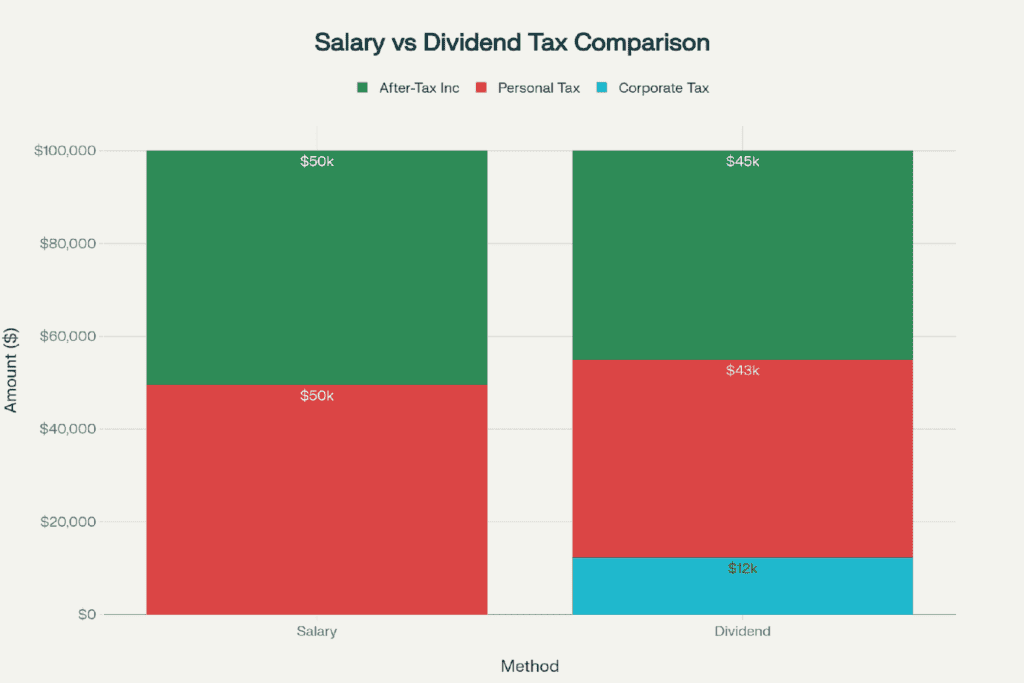
Salary vs Dividend Tax Comparison for Canadian Business Owners (Ontario 2024) – Based on $100,000 gross income
The analysis reveals that salary compensation provides superior after-tax results in most provinces, particularly when considering the value of RRSP contribution room generation.
Beyond Tax Considerations
Salary Advantages:
- Generates 18% RRSP contribution room annually
- Builds Canada Pension Plan (CPP) entitlements
- Enables Employment Insurance benefits (where applicable)
- Provides source deductions reducing year-end tax payments
- Supports Health Spending Account eligibility
- Allows claiming of moving expenses and childcare deductions
Dividend Advantages:
- Lower administrative burden (no payroll remittances)
- Potential for income splitting (subject to TOSI rules)
- No CPP or EI contributions required
- Greater flexibility in timing of distributions
- Preferred treatment for capital dividend account distributions
Shareholder Loan Strategies and Compliance
Current Rules and Requirements
The Canada Revenue Agency maintains strict rules governing shareholder loans to prevent tax avoidance while allowing legitimate business financing. As of Q2 2025, the prescribed interest rate stands at 4% annually.
Key Compliance Requirements:
- Documentation: Legal contract specifying loan amount, interest rate, and repayment terms
- One-Year Rule: Repayment required by end of following fiscal year or inclusion in income
- Interest Payments: Must be paid within 30 days of fiscal year-end
- Prescribed Rates: Must use CRA prescribed interest rates (currently 4%)
Solutions for Shareholder Loan Issues:
- Implement salary or dividend payments to clear outstanding balances
- Establish formal repayment schedules with appropriate documentation
- Consider debt forgiveness with proper tax planning for deemed dividends
- Utilize back-to-back loan prevention strategies
Motor Vehicle Benefits and Standby Charges
Calculation Methodology
The motor vehicle standby charge represents one of the most punitive taxable benefits in the Canadian tax system. The charge is calculated using the original cost of the vehicle throughout its useful life, creating significant tax burdens for expensive vehicles.
Owned Vehicle Formula:
Standby Charge = 2% × Original Cost × Number of Months Available
Leased Vehicle Formula:
Standby Charge = (2/3) × Monthly Lease Payment × Number of Months Available

Motor Vehicle Standby Charge Analysis by Vehicle Value (2024) – Regular vs Reduced Charges
Strategic Considerations
The analysis reveals that personal vehicle ownership with business mileage reimbursement often provides superior tax outcomes compared to corporate ownership, particularly for expensive vehicles.
Reduced Standby Charge Qualification:
- Business use exceeds 50% of available time
- Personal driving under 1,667 kilometers per month (20,004 annually)
- Reduction formula: Personal km ÷ (1,667 × months available)
Operating Cost Benefits:
- $0.33 per personal kilometer for 2024
- Alternative: 50% of standby charge if qualifying conditions met
RRSP Contributions from Company
Tax Treatment and Benefits
Employer RRSP contributions create a taxable benefit equal to the contribution amount, but this is immediately offset by the RRSP deduction, resulting in tax neutrality. The key advantage lies in the timing of tax benefits and improved cash flow.
Group RRSP Advantages:
- Pre-tax payroll deductions reduce withholding taxes
- Immediate tax savings rather than waiting for refunds
- Automatic dollar-cost averaging through regular contributions
- Enhanced convenience through payroll integration
Tax Mechanics:
- Employer contribution added to employment income
- Corresponding RRSP deduction claimed
- Net tax impact: neutral
- Cash flow impact: positive due to reduced withholdings
Health Spending Accounts (HSAs)
Tax Benefits and Structure
Health Spending Accounts represent one of the most tax-efficient employee benefits available, providing 100% tax deductibility for employers and 100% tax-free benefits for employees when properly structured
Qualification Requirements for Private Health Services Plan (PHSP):
- Must contain element of insurance risk
- Expenses must qualify as medical expenses under Income Tax Act
- 90% or more of benefits must be for eligible medical expenses
- Coverage must extend to employee and eligible dependents
Eligible Expenses Include:
- Prescription medications and medical devices
- Dental and vision care services
- Paramedical practitioner services
- Medical equipment and mobility aids
- Health practitioner consultations and treatments
Limitations:
- Sole proprietorships with no arm’s length employees cannot qualify
- Must maintain insurance element to avoid taxable benefit treatment
- Provincial variations (Quebec treats HSA benefits as taxable income)
Holdco vs. Opco Tax Planning
Tax Deferral Opportunities
Holding company structures provide significant tax deferral opportunities for business owners with excess corporate cash not required for personal consumption. The strategy leverages lower corporate tax rates compared to personal marginal rates.
Ontario Tax Deferral Example:
- Small business tax rate: 12.2%
- Top personal marginal rate: 53.53%
- Tax deferral advantage: 41.33%
This deferral allows more after-tax dollars to compound within the corporate structure until personal funds are required.
Strategic Benefits
Holdco Advantages:
- Tax-free intercorporate dividend flows
- Creditor protection for excess business assets
- Enhanced flexibility in dividend timing
- Estate planning and succession benefits
- Asset purification for Lifetime Capital Gains Exemption qualification
Considerations:
- Passive investment income rules may reduce small business deduction
- Additional corporate complexity and costs
- Association rules for related corporations
- Integration costs when funds eventually distributed
Estate Planning for Business Owners Over 50
Key Strategies and Considerations
Business owners over 50 face unique estate planning challenges, balancing current income needs with wealth preservation and transfer objectives. The analysis reveals several critical strategies for this demographic.
Lifetime Capital Gains Exemption (LCGE):
- 2024 exemption: $1.25 million for qualified small business corporation shares
- Requires 24-month qualification period
- Asset purification strategies may be necessary
- Coordination with holding company structures essential
Estate Freeze Strategies:
- Lock in current business value for tax purposes
- Transfer future growth to next generation
- Utilize wasting freeze for retirement income
- Coordinate with life insurance for tax liability funding
RRSP vs. Corporate Retention Decision:
For business owners over 50 with maximum RRSP room, the decision between personal RRSP withdrawals and corporate income retention requires careful analysis:
- RRSP withdrawals: Fully taxable at personal marginal rates
- Corporate retention: Lower initial corporate tax, but additional tax on eventual distribution
- Optimal strategy: Often involves combination approach based on annual income requirements
Industry-Specific Compensation Strategies
IT Consultants: Navigating Personal Service Business Rules
IT consultants face unique challenges with Personal Service Business (PSB) designation, which can dramatically increase tax rates and eliminate small business deductions
PSB Tax Impact:
- Normal corporate rate (Ontario): 12.2%
- PSB rate (Ontario): 44.5%
- Additional tax on $100,000: $32,300
PSB Avoidance Strategies:
- Maintain multiple client relationships
- Own equipment and bear financial risk
- Hire subcontractors and employees
- Demonstrate business substance beyond personal services
Compensation Strategy for PSB Designation:
If PSB designation unavoidable, optimal strategy involves salary and pension contributions to minimize corporate tax:
- Pay reasonable salary to reduce corporate income
- Maximize pension plan contributions (IPP or group RRSP)
- Utilize remaining corporate income for eligible dividends
- Result: Convert corporate tax into pension entitlements
Legal Professionals: Professional Corporation Considerations
Legal professionals operating through professional corporations must navigate specific regulatory requirements while optimizing tax efficiency.
Integration Analysis (British Columbia Example):
- Salary after-tax: $46,500
- Dividend after-tax: $45,490
- Salary advantage: $1,010
Key Considerations:
- Professional regulatory compliance requirements
- Client trust account management
- Professional liability insurance coordination
- Law society regulatory restrictions
Compensation Strategy:
Legal professionals should prioritize salary compensation for:
- Better tax integration results
- RRSP contribution room generation
- Professional regulatory compliance
- Reduced administrative complexity
Health Professionals: Maximizing Professional Corporation Benefits
Healthcare professionals with professional corporations have access to sophisticated tax planning strategies, subject to professional regulatory requirements.
Incorporation Benefits:
- Tax deferral on retained earnings
- Individual Pension Plan (IPP) opportunities
- Health Spending Account implementation
- Income splitting strategies (subject to TOSI rules)
Strategic Considerations:
- Medical malpractice insurance coordination
- Hospital privilege requirements
- Professional regulatory compliance
- College of Physicians requirements
Optimal Compensation Mix:
Healthcare professionals should consider:
- Salary sufficient for personal needs and RRSP maximization
- Dividend optimization for tax deferral
- IPP implementation for enhanced retirement savings
- HSA utilization for tax-free health benefits[
SaaS Owners: Digital Economy Tax Compliance
Software-as-a-Service business owners face complex tax obligations related to digital service provision across multiple jurisdictions.
GST/HST Considerations:
- Registration threshold: $30,000 in taxable supplies
- Ontario HST rate: 13%
- Quebec combined rate: 14.975%
- Provincial variations significant
Tax Planning Strategies:
- Proper GST/HST registration and compliance
- International tax treaty optimization
- Provincial sales tax minimization
- Corporate structure optimization for multiple jurisdictions
Compensation Optimization:
SaaS owners should focus on:
- Corporate tax rate optimization through jurisdiction selection
- Dividend strategies for lower personal tax rates
- International tax planning for global operations
- Professional tax advice for complex digital economy rules
Advanced Tax Planning Strategies
Income Splitting Opportunities and TOSI Rules
The Tax on Split Income (TOSI) rules significantly limit income splitting opportunities for business owners, but exceptions exist for legitimate business involvement.
TOSI Exceptions:
- Spouse working 20+ hours weekly in business
- Adult children with substantial business involvement
- Arm’s length dividends and reasonable returns on investment
- Inherited business income
Shareholder Loan Optimization
Strategic use of shareholder loans can provide tax-efficient access to corporate funds while maintaining compliance.
Best Practices:
- Document all loans with formal agreements
- Charge prescribed interest rates
- Maintain regular payment schedules
- Consider loan forgiveness timing for tax optimization
Estate Planning Integration
Business owners require comprehensive estate planning that coordinates tax minimization with succession planning objectives
Key Elements:
- Wills and estate documentation
- Powers of attorney for business continuity
- Life insurance for tax liability funding
- Succession planning for business continuity
- Asset purification for LCGE qualification
Implementation Recommendations
Annual Tax Planning Process
Business owners should implement systematic annual tax planning incorporating:
- Income forecasting and compensation optimization
- RRSP and pension contribution maximization
- Tax deferral strategy review
- Estate planning updates
- Professional regulatory compliance verification
Professional Advisory Team
Optimal tax planning requires coordination among:
- Chartered Professional Accountants (CPAs) specializing in owner-manager compensation
- Tax lawyers for complex structures and compliance
- Financial planners for retirement and estate planning
- Insurance professionals for risk management and estate planning
Monitoring and Adjustment
Tax laws and rates change frequently, requiring ongoing monitoring and strategy adjustment. Business owners should:
- Review compensation mix annually
- Monitor provincial tax rate changes
- Assess new tax legislation impacts
- Adjust strategies based on business and personal circumstances
Conclusion
Effective tax planning for Canadian business owners and shareholders requires sophisticated analysis extending well beyond simple tax rate comparisons. The optimal compensation strategy varies based on income levels, provincial jurisdiction, industry-specific considerations, and personal financial objectives. While salary compensation often provides superior after-tax results and retirement planning benefits, dividend strategies offer administrative simplicity and potential tax deferral opportunities.
The analysis reveals that successful tax planning requires integration of multiple strategies including motor vehicle benefits optimization, Health Spending Account implementation, holding company structures, and estate planning coordination. Industry-specific considerations, particularly Personal Service Business rules for IT consultants and professional regulatory requirements for legal and health professionals, significantly impact optimal strategies.
Business owners should work with qualified professional advisors to implement comprehensive tax planning strategies that optimize both current tax burdens and long-term wealth accumulation objectives. Regular review and adjustment of strategies remains essential given the evolving nature of Canadian tax legislation and provincial rate variations.
Key Takeaways:
- Salary compensation generally provides superior after-tax results when considering RRSP benefits
- Motor vehicle corporate ownership creates significant taxable benefits requiring careful analysis
- Health Spending Accounts offer exceptional tax efficiency when properly structured
- Industry-specific rules significantly impact optimal compensation strategies
- Estate planning integration becomes critical for business owners over 50
- Professional advisory coordination essential for optimal results
The comprehensive nature of Canadian tax planning for business owners demands professional expertise and ongoing attention to achieve optimal results while maintaining full compliance with complex regulatory requirements.
Read More
- https://www.canada.ca/en/revenue-agency/services/tax/technical-information/income-tax/income-tax-folios-index/series-3-property-investments-savings-plans/series-3-property-investments-savings-plan-folio-2-dividends/income-tax-folio-s3-f2-c2-taxable-dividends-corporations-resident-canada.html
- https://www.achenhenderson.ca/corporate-tax-accountants/salaries-vs-dividends/
- https://turbotax.intuit.ca/tips/salary-or-dividends-how-to-pay-yourself-as-a-business-owner
- https://lrktax.ca/resource/salary-vs-dividends/
- https://www.canada.ca/en/revenue-agency/services/tax/technical-information/income-tax/income-tax-folios-index/series-3-property-investments-savings-plans/folio-1-shares-shareholders-security-transactions/income-tax-folio-s3-f1-c1-shareholder-loans-debts.html
- https://www.purposecpa.ca/what-is-a-standby-charge-for-business-vehicles/
- https://www.protaxcommunity.com/t/shareholder-benefits-from-company-vehicle/7968
- https://www.canada.ca/en/revenue-agency/services/tax/businesses/topics/payroll/benefits-allowances/automobile/automobile-motor-vehicle-benefits/automobile.html
- https://www.kwbllp.com/2019/03/05/vehicle-ownership/
- https://www.rcgt.com/en/tax-planning-guide/sections/section-05-employees/taxable-benefits/
- https://www.revenuquebec.ca/en/businesses/source-deductions-and-employer-contributions/special-cases-source-deductions-and-employer-contributions/taxable-benefits/list-of-taxable-benefits/other-benefits/rrsp-contributions-made-by-the-employer/
- https://www.reddit.com/r/PersonalFinanceCanada/comments/ryb614/employer_rrsp_match_taxable_benefit_explanation/
- https://www.mackenzieinvestments.com/content/dam/final/corporate/mackenzie/images/web/services/mm-group-rrsps-the-extra-edge-en.pdf
- https://investingquestions.ca/question/if-my-employer-puts-a-percentage-of-my-income-as-an-rrsp-contribution-should-this-amount-be-added-to-earned-income/
- https://support.commonwealthretirement.com/hc/en-us/articles/4410283146775-When-to-include-contributions-when-applying-payroll-deductions
- https://www.simplybenefits.ca/post/health-spending-accounts-for-canadians-explained
- https://www.dundaslife.com/blog/health-spending-account-hsa-in-canada
- https://taxpage.com/articles-and-tips/your-health-spending-account-hsa-benefits-and-tax-consequences-for-employers-employees/
- https://www.pac.bluecross.ca/member-privileges/how-can-we-help-you/health-spending-account-faq/
- https://mclaughlinteam.ca/tax-planning-considerations-for-owning-a-holding-corporation/
- https://enrichedthinking.scotiawealthmanagement.com/2025/05/27/tax-planning-considerations-for-owning-a-holding-corporation/
- https://www.cibc.com/content/dam/personal_banking/advice_centre/tax-savings/holding-companies-en.pdf
- https://opendoorlaw.com/practices/business-law/opco-holdco/
- https://www.ig.ca/en/insights/estate-planning-priorities-for-business-owners
- https://shajani.ca/planning-for-retirement-a-guide-for-family-owned-enterprises-in-canada/
- https://www.rbcwealthmanagement.com/en-ca/podcasts/episode-31-estate-planning-tips-for-business-owners
- https://nesbittburns.bmo.com/SurconMahoneyWealthManagement/blog/741125-top-10-retirement-strategies-for-canadian-small-business-owners-and-professionals
- https://jeremyscott.ca/wealth-transfer-tax-planning-strategies-for-canadian-businesses/
- https://www.deloitte.com/ca/en/services/tax/perspectives/an-updated-perspective-of-owner-manager-compensation.html
- https://integris-mgt.com/blog/why-should-it-consultants-care-about-psb-rules/
- https://www.canada.ca/en/revenue-agency/services/tax/canada-pension-plan-cpp-employment-insurance-ei-rulings/cpp-ei-explained/canada-pension-plan-employment-insurance-explained-information-technology-consultants-employees-self-employed-workers.html
- https://www.serbinski.com/presentation-it-consultants-tax-issues
- https://23165537.fs1.hubspotusercontent-na1.net/hubfs/23165537/Lead Magnets/Top 10 Tax Principles for Self-Employed Canadian Lawyers in 2024-1.pdf
- https://www.cibc.com/content/dam/small_business/day_to_day_banking/advice_centre/pdfs/business_reports/professional-inc-en.pdf
- https://taxpartners.ca/public/strategic-tax-planning-for-canadian-medical-professionals-a-guide-to-maximizing-financial-stability
- https://shandalcpa.com/blog/2025/02/05/tax-planning-for-health-professionals-in-canada-an-essential-guide/
- https://invested.mdm.ca/tax-tips-for-physicians/
- https://www.dr-bill.ca/blog/wealth-finances/tax-planning-qa-for-canadian-physicians
- https://www.bakertilly.ca/insights/salary-vs.-dividend-for-medical-professionals
- https://windsordrake.com/sell-my-saas-canada/
- https://mbaccounting.ca/understanding-saas-taxes-in-canada-is-your-software-taxable/
- https://www.zeifmans.ca/saas-entrepreneurs-face-unique-accounting-and-tax-challenges/
- https://saasinsurance.ca/business-owners/tax-planning-strategies-for-canadian-business-owners/
- https://www.canada.ca/en/revenue-agency/programs/about-canada-revenue-agency-cra/federal-government-budgets/income-sprinkling/guidance-split-income-rules-adults.html
- https://www.parrbusinesslaw.com/blog/estate-planning-for-small-business-owners
- https://www.purposecpa.ca/what-are-the-considerations-when-taking-salary-or-dividends-in-my-corporation/
- https://cardinalpointwealth.com/2023/05/15/canadian-business-owner-manager-remuneration-planning/
- https://www.canada.ca/en/revenue-agency/services/tax/technical-information/income-tax-audit-manual-domestic-compliance-programs-branch-dcpb-24.html
- https://www.canada.ca/content/dam/fin/migration/n17/data/tppc-pfsp-eng.pdf
- https://www.canada.ca/en/department-finance/programs/consultations/2017/tax-planning-using-private-corporations.html
- https://www.canada.ca/en/revenue-agency/services/tax/businesses/topics/payroll/benefits-allowances/security-options.html
- https://www.canada.ca/en/revenue-agency/services/tax/businesses/topics/corporations/eligible-dividends.html
- https://www.canada.ca/en/revenue-agency/services/tax/individuals/topics/about-your-tax-return/tax-return/completing-a-tax-return/deductions-credits-expenses/line-22900-other-employment-expenses/employees-shareholders.html
- https://www.canada.ca/en/revenue-agency/services/tax/businesses/topics/corporations/eligible-dividends/part-1-tax.html
- https://www.canada.ca/en/revenue-agency/services/forms-publications/publications/t4012/t2-corporation-income-tax-guide-chapter-6-pages-6-7-t2-return.html
- https://fbc.ca/blog/unreasonable-relative-pay-corporation/
- https://www.canada.ca/en/revenue-agency/services/tax/businesses/topics/payroll/file-information-returns-slip-summaries/make-corrections-after-filing.html
- https://taxlawcanada.com/compensation-for-business-owners-how-benefits-are-taxed-for-shareholders-and-shareholder-employees/
- https://www.canada.ca/en/revenue-agency/services/tax/businesses/topics/completing-slips-summaries/financial-slips-summaries/return-investment-income-t5/deemed-dividends.html
- https://hr.ubc.ca/wellbeing-benefits/files/HSA-List-of-eligible-expenses-Feb07.pdf
- https://www.connectcpa.ca/blog/the-tax-benefits-of-a-holding-company-for-your-business
- https://lifeaccount.ca/health-spending-account-hsa-in-canada/
- https://kalfalaw.com/whats-the-right-structure-part-1-holding-company-vs-operating-company/
- https://www.nerdwallet.com/ca/p/article/banking/about-rrsp-matching-programs
- https://www.canada.ca/en/revenue-agency/news/newsroom/tax-tips/tax-tips-2019/warning-buyer-beware-when-it-comes-to-health-spending-accounts.html
- https://www.ryan.com/contentassets/26e17bf16f714d6987f3bdab3ee8c0f1/cra-employes-guide-t4130.pdf
- https://verticalcpa.ca/can-i-expense-my-car/
- https://enrichedthinking.scotiawealthmanagement.com/2025/02/06/whitepaper-unlocking-your-legacy-empowering-canadians-in-estate-planning/
- https://www.canada.ca/en/revenue-agency/services/tax/businesses/topics/payroll/benefits-allowances/automobile/automobile-motor-vehicle-benefits.html
- https://www.doanegrantthornton.ca/insights/estate-planning-a-powerful-strategy-for-your-family-and-business/
- https://mccayduff.com/navigating-vehicle-ownership-shareholder-vs-corporation/
- https://escarpmentadvisory.ca/unlocking-your-legacy-empowering-canadians-in-estate-planning/
- https://cncpa.ca/cra-motor-vehicle-tax-deduction-for-business/
- https://www.mnp.ca/en/insights/directory/integration-incorporation-and-compensation-planning-navigating-professional-income-tax-strategies
- https://www.manulifeim.com/retail/ca/en/viewpoints/tax-planning/professional-corporations-offer-tax-breaks
- https://www.srjca.com/comprehensive-guide-to-structuring-compensation-for-canadian-business-owners/
- https://privatewealth-insights.bmo.com/en/insights/business-owners/tax-planning-for-physicians-professional-corporations/
- https://webtaxonline.ca/know-how-to-save-taxes-as-an-it-consultant/
- https://invested.mdm.ca/how-dividends-are-taxed-in-canada/
- https://cncpa.ca/automobile-taxable-benefit/
- https://www.driversnote.ca/blog/company-cars-what-employers-need-to-know-about-automobile-taxable-benefit
- https://www.bdo.ca/insights/owner-manager-remuneration-tax-strategies
- https://www.taxtips.ca/smallbusiness/automobile-operating-cost-benefit.htm
- https://qopiafinancial.ca/estate-planning-for-business-owners/
- https://saasinsurance.ca/business-owners/canadian-tax-planning-for-small-businesses/
- https://www.canada.ca/en/revenue-agency/services/e-services/digital-services-businesses/automobile-benefits-online-calculator-disclaimer.html
- https://ppl-ai-code-interpreter-files.s3.amazonaws.com/web/direct-files/ae1034672c47e3af6b77ca9573df1b2b/4808523d-606b-4c0e-9a4f-c4f89418f26e/1e8d6250.json
- https://ppl-ai-code-interpreter-files.s3.amazonaws.com/web/direct-files/ae1034672c47e3af6b77ca9573df1b2b/3238519b-0942-4d04-9769-f3cc74b1f0a3/cc67dead.csv
- https://ppl-ai-code-interpreter-files.s3.amazonaws.com/web/direct-files/ae1034672c47e3af6b77ca9573df1b2b/3238519b-0942-4d04-9769-f3cc74b1f0a3/bcb70709.csv