
Advanced International Compensation Strategies: Navigating the New Global Tax Transparency Era
The landscape of international compensation strategies has fundamentally transformed in recent years. Traditional offshore and tax haven schemes have become largely obsolete due to unprecedented global tax transparency initiatives, enhanced reporting requirements, and severe penalties for non-compliance. Modern international compensation planning requires sophisticated understanding of legitimate structures that operate within the evolving framework of global tax cooperation
The End of Traditional Offshore Schemes
Global Tax Transparency Revolution
The implementation of the Common Reporting Standard (CRS) across over 100 countries, including Canada since July 1, 2017, has effectively eliminated the secrecy that once enabled aggressive offshore tax strategies. Financial institutions worldwide now automatically exchange detailed account information, making hidden offshore assets easily detectable by tax authorities.
Key Transparency Measures:
- Automatic Information Exchange: Annual sharing of financial account data between 100+ countries
- Country-by-Country Reporting: Multinational enterprises must report global income allocation
- Enhanced Trust Reporting: Comprehensive beneficial ownership disclosure requirements
- Base Erosion and Profit Shifting (BEPS): Coordinated attack on artificial profit shifting
Escalating Penalties and Enforcement
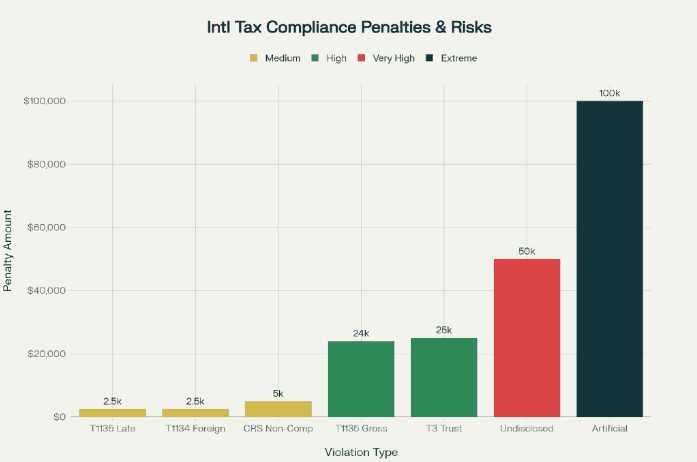
International Tax Compliance Penalties and Risk Assessment – Escalating consequences for various types of non-compliance
The penalty structure for international tax non-compliance has become increasingly punitive, with consequences extending far beyond financial penalties to include criminal prosecution and extended audit periods.
Critical Compliance Requirements:
- T1135 Foreign Property Reporting: $100,000+ threshold with penalties up to $24,000 plus 5% of property value
- Foreign Trust Reporting: New T3 filing requirements with penalties up to $25,000
- Controlled Foreign Affiliate Rules: Significantly reduced tax deferral benefits for CCPCs
- Undisclosed Foreign Income: 50% penalties plus potential criminal charges
Legitimate International Compensation Strategies
Tax Equalization and Protection Policies
Modern international compensation planning focuses on legitimate business structures that provide tax efficiency while maintaining full transparency and compliance.
Tax Equalization Implementation:
- Hypothetical Tax Calculation: Determine home country tax liability as if employee remained domestic
- Host Country Tax Management: Employer pays all actual host country taxes
- Employee Contribution: Employee pays hypothetical tax amount to employer
- Annual True-Up: Reconcile actual costs with estimates
Strategic Benefits:
- Employee Neutrality: No tax advantage or disadvantage from international assignment
- Predictable Costs: Employers can budget effectively for global mobility programs
- Enhanced Acceptance: Removes tax considerations from assignment decisions
- Compliance Assurance: Transparent structure reduces audit risk
Advanced Global Mobility Structures
International Service Companies:
Legitimate centralized employment structures can provide tax efficiency while maintaining economic substance and business purpose.
- Centralized Expertise: Specialized global mobility management
- Cost Efficiency: Economies of scale in administration and compliance
- Risk Management: Professional oversight of complex international requirements
- Transfer Pricing Compliance: Arms-length compensation for services provided
Split-Payroll Arrangements:
Sophisticated division of compensation between jurisdictions based on actual work performance and economic reality.
- Home Country Elements: Base salary, pension contributions, certain benefits
- Host Country Elements: Performance bonuses, cost-of-living adjustments, local benefits
- Documentation Requirements: Comprehensive records supporting allocation methodology
- Business Justification: Clear economic rationale for compensation split
Current Global Mobility Cost Analysis
Modern international assignments require comprehensive cost management that accounts for tax equalization, compliance costs, and enhanced reporting requirements:
Assignment Cost Breakdown (USD $150,000 base salary):
- Short-term (6 months): Total package cost $226,000 (151% of base)
- Long-term (3 years): Total package cost $838,000 (186% of base annually)
- Permanent transfer: Total package cost $232,000 (155% of base)
These costs reflect the reality that legitimate international compensation requires significant investment in compliance, professional services, and employee support systems.
Controlled Foreign Affiliate Complications
Recent changes to Canada’s foreign affiliate rules have dramatically reduced the tax benefits of offshore corporate structures for Canadian-controlled private corporations.
Relevant Tax Factor Reduction Impact:
- Previous System (RTF 4.0): CCPCs could achieve full tax deferral on foreign passive income
- Current System (RTF 1.9): Significant Canadian tax inclusion even with 25% foreign tax rates
- Financial Impact: Additional $26,384 Canadian tax on $100,000 of foreign passive income
Strategic Implications:
- Reduced Deferral Benefits: Traditional offshore structures less attractive for CCPCs
- Compliance Complexity: Enhanced reporting and calculation requirements
- Professional Oversight: Mandatory involvement of tax specialists and actuaries
- Alternative Strategies: Focus shifts to domestic tax planning and legitimate business operation
Enhanced Reporting and Compliance Requirements
Foreign Trust Reporting Revolution
New trust reporting rules effective for taxation years ending after December 30, 2023, require comprehensive disclosure of beneficial ownership information.
Expanded Filing Requirements:
- Express Trusts: All resident trusts must file T3 returns annually
- Deemed Resident Trusts: Enhanced disclosure for foreign trusts with Canadian connections
- Schedule 15: Detailed beneficial ownership information required
- Bare Trusts: Relief provided for 2023-2024, but future compliance uncertain
Compliance Implications:
- Professional Advice Essential: Complex determination of filing requirements
- Severe Penalties: Up to $25,000 for non-compliance
- No Statute of Limitations: Files remain open until proper compliance achieved
- Audit Triggers: Non-compliance significantly increases examination risk
Foreign Property Disclosure Enhancement
The T1135 foreign property reporting regime continues to evolve with enhanced scrutiny and expanded interpretation of reportable property.
Current Requirements:
- Threshold: $100,000 CAD cost amount at any time during the year
- Scope: Foreign bank accounts, securities, real estate, trust interests
- Timing: Due with annual tax return
- Documentation: Detailed records of property acquisition and disposition
Escalating Enforcement:
- Automatic Penalties: $25 per day up to $2,500 for late filing
- Gross Negligence: Additional penalties up to $24,000 or 5% of property value
- Extended Statute: Six-year reassessment period for entire tax return
- Criminal Investigation: Potential prosecution for wilful non-compliance
Legitimate Tax Planning Strategies
Domestic Optimization Focus
Given the challenges with international structures, sophisticated tax planning now emphasizes domestic Canadian strategies with full transparency.
Priority Strategies:
- Individual Pension Plans: Enhanced contribution limits for business owners over 40
- Capital Dividend Account Optimization: Strategic timing of gains realization and distributions
- Corporate Life Insurance: Tax-efficient premium funding and estate planning
- Health Spending Accounts: 100% tax-free employee benefits with proper structure
Professional Integration Requirements
Modern international compensation strategies demand unprecedented professional coordination.
Essential Advisory Team:
- International Tax Specialists: Cross-border compliance and planning expertise
- Global Mobility Consultants: Assignment structuring and policy development
- Transfer Pricing Experts: Arms-length pricing for intercompany services
- Employment Lawyers: Compliance with multiple jurisdictions’ labor laws
- Immigration Specialists: Work authorization and residency planning
Risk Assessment and Compliance Framework
High-Risk Strategy Identification
The following approaches carry extreme compliance risk and should be avoided:
Prohibited or High-Risk Strategies:
- Undisclosed Foreign Accounts: Criminal prosecution risk with 50%+ penalties
- Artificial Offshore Structures: Severe penalties under BEPS and CRS rules
- Sham International Assignments: Employment law violations and tax consequences
- Aggressive Trust Structures: Enhanced reporting requirements and penalties
- Tax Haven Shell Companies: Substance requirements and automatic disclosure
Best Practice Implementation
Compliance Excellence Framework:
- Comprehensive Documentation: Maintain detailed records supporting all international structures
- Economic Substance: Ensure genuine business purpose and operational reality
- Professional Oversight: Engage qualified advisors for design and ongoing compliance
- Regular Review: Annual assessment of changing requirements and optimization opportunities
- Transparent Reporting: Full disclosure of all international arrangements and obligations
Future Outlook and Strategic Recommendations
Evolving Regulatory Environment
The international tax landscape continues evolving toward greater transparency and coordination:
Anticipated Developments:
- Enhanced CRS Reporting: Expanded scope and more frequent information exchange
- Digital Asset Transparency: Cryptocurrency and digital asset reporting requirements
- Beneficial Ownership Registries: Public disclosure of ultimate beneficial ownership
- Multilateral Cooperation: Increased coordination between tax authorities globally
Strategic Positioning
Recommended Approach:
- Embrace Transparency: Design structures that benefit from rather than avoid disclosure
- Focus on Substance: Emphasize genuine business activities and economic value creation
- Invest in Compliance: Professional oversight as competitive advantage rather than cost
- Domestic Optimization: Maximize benefits of sophisticated Canadian tax planning strategies
- Global Mobility Excellence: Leverage legitimate international assignment structures for business advantage
Conclusion
The era of aggressive offshore tax schemes and secretive compensation arrangements has definitively ended. The combination of global tax transparency initiatives, enhanced reporting requirements, and severe penalties for non-compliance has fundamentally transformed the international tax landscape.
Modern international compensation strategies must operate within a framework of full transparency, economic substance, and comprehensive compliance. While this represents increased complexity and cost, it also creates opportunities for sophisticated organizations to gain competitive advantages through superior global mobility programs and legitimate tax optimization strategies.
Key Strategic Principles:
- Transparency Over Secrecy: Embrace disclosure as competitive advantage
- Substance Over Form: Focus on genuine business activities and value creation
- Compliance as Investment: Professional oversight essential for success
- Domestic Excellence: Maximize benefits of sophisticated Canadian tax strategies
- Global Integration: Leverage legitimate international structures for business advantage
The most sophisticated compensation strategies now involve transparent, well-documented arrangements that create genuine value while maintaining full compliance with evolving international standards. Organizations that master these approaches will achieve sustainable competitive advantages in global talent management while avoiding the severe risks associated with aggressive tax planning schemes.
Critical Success Factors:
- Comprehensive professional advisory coordination
- Robust documentation and substance requirements
- Regular compliance monitoring and adjustment
- Strategic focus on legitimate business objectives
- Proactive engagement with evolving regulatory requirements
Success in the modern international compensation environment requires embracing transparency, investing in professional expertise, and focusing on strategies that create genuine business value while maintaining impeccable compliance with global tax standards.
References
Read More
- https://www.thor.ca/blog/2016/03/government-moving-forward-with-the-automatic-exchange-of-tax-information/
- https://www.rbc.com/regulatory-information/crs.html
- https://www.canada.ca/en/revenue-agency/services/tax/international-non-residents/enhanced-financial-account-information-reporting/reporting-sharing-financial-account-information-other-jurisdictions/guidance-on-common-reporting-standard-part-income-tax-act.html
- https://www.oecd.org/en/topics/sub-issues/international-standards-on-tax-transparency/tax-transparency-resource-centre.html
- https://en.wikipedia.org/wiki/Common_Reporting_Standard
- https://www.canada.ca/en/revenue-agency/services/forms-publications/publications/rc4651/guidance-on-country-country-reporting-canada.html
- https://www.cpasolutions.ca/the-complexity-of-assessing-t1135-penalties
- https://fariscpa.com/cra-forms/cra-t1135-form/
- https://www.canada.ca/en/revenue-agency/services/tax/international-non-residents/information-been-moved/foreign-reporting/questions-answers-about-penalties.html
- https://www.gtn.com/blog/what-is-tax-equalization-and-how-does-it-impact-your-mobile-employees-and-company
- https://www.bakertilly.ca/insights/temporary-assignment-of-an-employee-from-canada-to-the-united-states1
- https://www.omnipresent.com/articles/tax-equalization-for-expats
- http://www.grasmick.com/equalize.htm
- https://www.bennettjones.com/-/media/Files/BennettJones/Shared/CrossBorder-Employment-Issues-Ensuring-a-Successful-Assignment-to-Cana.pdf
- https://www.the-strategic-chro.com/blog/understanding-global-mobility-compensation-package-models-for-international-assignments
- https://ataylormoving.com/blog/what-is-global-mobility-tax
- https://www.doanegrantthornton.ca/service/tax/cross-border-personal-tax/global-mobility-services/
- https://www.osler.com/osler/media/Osler/Content/PDFs/Managing-the-Tax-Impact-of-Cross-Border-Remote-Work-Arrangements-A-Canadian-Perspective.pdf
- https://rsmcanada.com/insights/services/business-tax-insights/new-rules-for-canadian-corporations-earning-passive-income.html
- https://www.blg.com/en/insights/2023/09/harmful-tax-rule-changes-affecting-canadian-owned-foreign-real-estate-businesses
- https://turbotax.intuit.ca/tips/t3-tax-form-trust-income-in-canada-403
- https://www.bakertilly.ca/insights/taxalert-new-trust-reporting-rules
- https://www.thomsonreuters.ca/en/dtprofessionalsuite/blog/new-trust-reporting-requirements-for-t3-returns.html
- https://www.canada.ca/en/revenue-agency/services/tax/trust-administrators/t3-return/enhanced-reporting-rules-trusts-bare-trusts-faq.html
- https://ca.rbcwealthmanagement.com/documents/1435520/3126715/NAV0097_Foreign+Income+Verification+Statement_aoda_EN_220822.pdf/899d7500-51e9-4fe1-b8d4-a25274365751
- https://wellington-altus.ca/how-should-i-compensate-myself-salary-or-dividends/
- https://mclaughlinteam.ca/tax-planning-considerations-for-owning-a-holding-corporation/
- http://www.cdspi.com/learn/when-to-consider-an-individual-pension-plan/
- https://taxpartners.ca/public/strategic-tax-planning-for-canadian-medical-professionals-a-guide-to-maximizing-financial-stability
- https://www.purposecpa.ca/what-are-the-considerations-when-taking-salary-or-dividends-in-my-corporation/
- https://laws-lois.justice.gc.ca/eng/acts/I-3.3/section-95.html
- https://www.eylaw.ca/en_ca/newsroom/2024/tax-alert-2024-no-02
- https://www.bdo.ca/insights/navigating-the-evolution-of-eifel-rules-from-proposal-to-final-legislation
- https://www.canada.ca/en/revenue-agency/services/tax/international-non-residents/information-been-moved/foreign-reporting/information-returns-relating-foreign-affiliates.html
- https://www.knowledgebureau.com/site/KBR/late-filing-of-t1135-what-you-need-to-know
- https://www.canada.ca/en/revenue-agency/services/forms-publications/publications/t4013/t3-trust-guide.html
- https://www.canada.ca/en/revenue-agency/programs/about-canada-revenue-agency-cra/compliance/excessive-interest-financing-expenses-limitation-rules.html
- https://vialtopartners.com/regional-alerts/canada-global-mobility-tax-2024-federal-budget
- https://www.bakertilly.ca/insights/temporary-assignment-of-an-employee-from-canada-to-the-united-states
- https://www.canada.ca/en/revenue-agency/services/tax/businesses/topics/payroll/benefits-allowances/provided/moving-expenses-relocation-benefits.html
- https://www.oecd.org/en/networks/global-forum-tax-transparency/resources/aeoi-implementation-portal/crs-by-jurisdiction.html
- https://velocityglobal.com/resources/blog/global-mobility-compensation-packages/
- https://ppl-ai-code-interpreter-files.s3.amazonaws.com/web/direct-files/afd410b4013ca38df7ead9b98e3a16ff/d04ef62d-6de2-4b81-ac5d-58e23e32b809/205fe1e6.csv
- https://ppl-ai-code-interpreter-files.s3.amazonaws.com/web/direct-files/afd410b4013ca38df7ead9b98e3a16ff/d04ef62d-6de2-4b81-ac5d-58e23e32b809/9c2cc66c.json
- https://ppl-ai-code-interpreter-files.s3.amazonaws.com/web/direct-files/afd410b4013ca38df7ead9b98e3a16ff/d04ef62d-6de2-4b81-ac5d-58e23e32b809/a6567779.csv